

The Maras Salt Mines, also known as the Salineras de Maras, are thousands of terraced salt ponds built into a mountainside in the Sacred Valley near Cusco. Fed by naturally salty water and worked using traditional methods that date back to pre-Inca times, they remain an active salt-production site as well as one of the most distinctive landscapes in the region.
A visit to Maras is different from exploring an archaeological site. Here, the main attraction is a living system: water still moves through narrow channels, salt still crystallizes inside the ponds, and local communities continue practices passed down through generations.
If you are planning a trip from Cusco, this guide explains what the Maras Salt Mines are, how they work, when to visit and how to combine them with nearby Moray.
What Are the Maras Salt Mines?
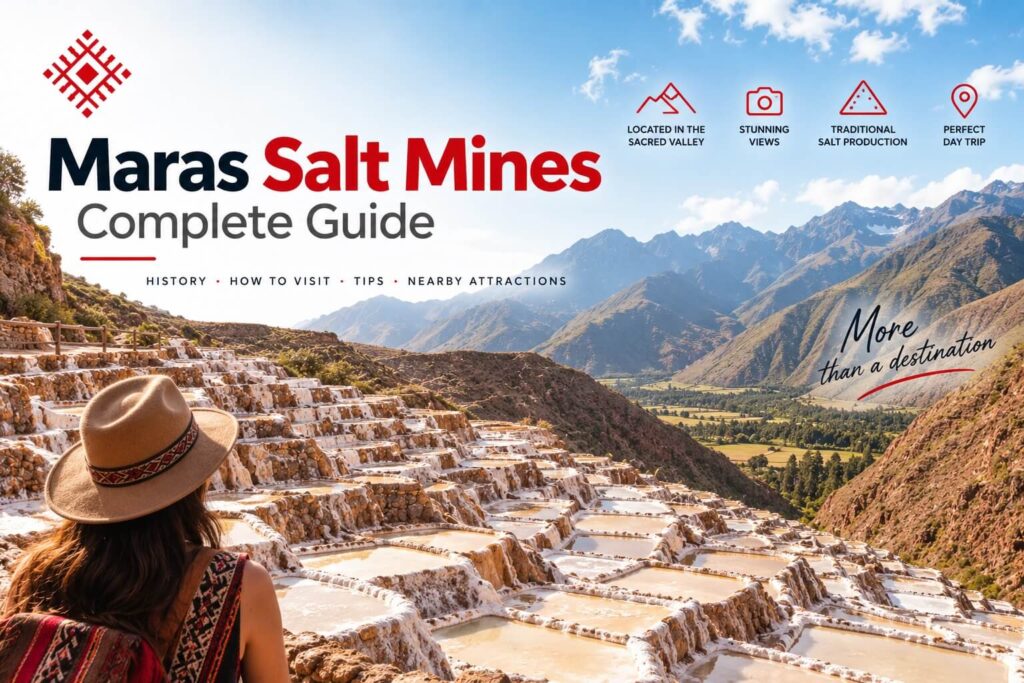
The Maras Salt Mines are a large complex of shallow salt ponds arranged in terraces along the slope of Qaqawiñay hill.
According to the UNESCO World Heritage Centre, the site contains approximately 4,500 salt wells covering around 1.5 to 2 hectares. A system of channels distributes naturally salty spring water among the individual ponds.
Instead of mining solid deposits underground, salt is produced here through evaporation. Water enters the ponds, the Andean sun gradually evaporates it, and layers of crystallized salt remain behind to be harvested.
Although commonly called the “salt mines,” they are therefore better understood as salt evaporation ponds.
Where Are the Maras Salt Mines Located?
The salt ponds are located in the Maras district of Urubamba Province, Cusco Region, within the wider Sacred Valley area.
UNESCO places them approximately 50 kilometers from Cusco and at around 3,200 meters (10,500 feet) above sea level. They lie below the town of Maras, on a mountainside descending toward the Vilcanota River valley.
Their location makes them practical to visit as a day or half-day excursion from Cusco, especially when combined with Moray.
Travelers planning more time in the region can also explore the wider Sacred Valley of the Incas tour, which focuses on other important sites and settlements in the valley.
Why Are the Maras Salt Mines Famous?
Maras stands out for three main reasons: its landscape, its traditional salt-production system and its long cultural continuity.
From the viewpoints above the site, thousands of small geometric ponds spread across the mountainside in shades that can range from bright white and cream to pink and brown. Their appearance changes according to water levels, salt concentration and season.
But Maras is more than a photogenic stop. It remains a productive landscape managed by local communities. The combination of natural resources, human engineering and traditional community organization is what makes the site particularly significant.
It is also important to understand its UNESCO status correctly: the Salt Mines of Maras were submitted by Peru to UNESCO’s Tentative List in 2019. They are not currently an inscribed UNESCO World Heritage Site.
The History of the Maras Salt Mines
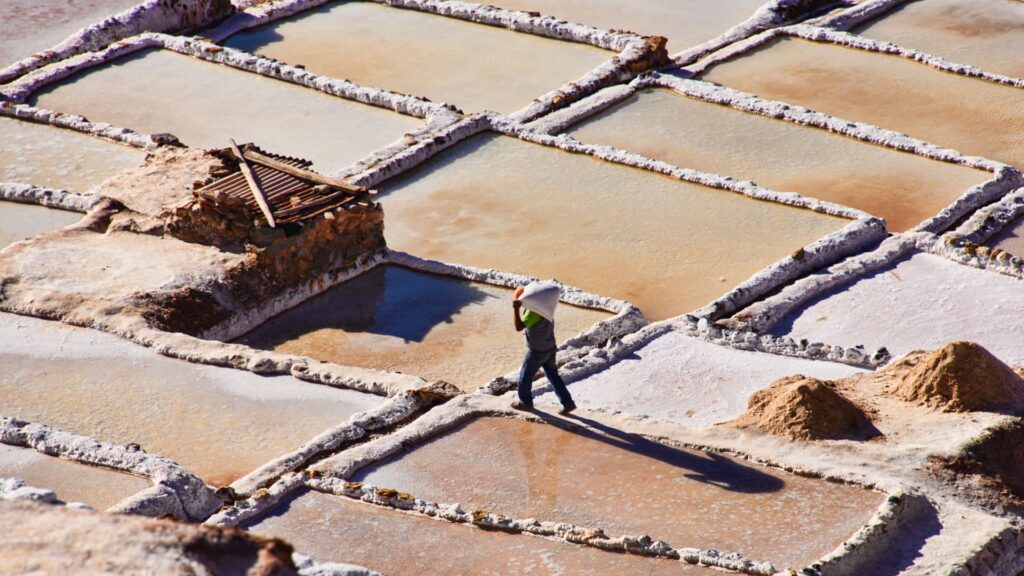
Salt production at Maras predates the Inca Empire.
Archaeological evidence in the surrounding area indicates salt exploitation during pre-Inca periods, while the network of ponds, channels and associated routes continued to be used and developed during Inca, colonial, republican and modern times.
This long continuity is one reason Maras is especially interesting: visitors are not looking at a reconstructed ancient technique. They are seeing a traditional production system that has remained in use for centuries.
Maras Before and During the Inca Empire
Archaeological evidence around Maras shows occupation and salt exploitation well before the height of the Inca Empire.
UNESCO’s Tentative List documentation mentions archaeological material associated with different pre-Hispanic periods and states that the system has operated from pre-Inca times to the present. Later, under Inca influence, salt production became integrated into wider regional systems of exchange and administration.
Pre-Hispanic routes connected the salt-producing area with other parts of the Cusco region, allowing salt to be exchanged for agricultural products.
This distinction matters: describing the Maras Salt Mines simply as an “Inca creation” misses much of their history. The Incas used and developed a salt-producing landscape whose origins were earlier.
The Legend of Ayar Cachi and the Salt Waters
Alongside its archaeological history, Maras is connected to Andean oral tradition.
One well-known legend relates the salty waters to Ayar Cachi, one of the mythical siblings associated with the origin stories of the Incas. In popular versions of the story, Ayar Cachi’s tears became the salty water that flows through the mountain.
The story forms part of the cultural interpretation surrounding Maras, but it should be understood as legend rather than a historical explanation for the spring.
That distinction makes both aspects more meaningful: visitors can appreciate the oral tradition while also understanding the physical salt-production system they see today.
Maras and Pichingoto Communities Today
The salt ponds are not simply remnants of the past. Production continues through the communities of Maras and Pichingoto.
Traditional relationships of ownership, cooperation and inheritance remain part of the way the salt ponds are managed. UNESCO’s documentation describes the production system as communal and notes that rights to individual ponds have traditionally passed from parents to children.
This makes respectful tourism especially important. Maras is both a visitor attraction and a working environment where an edible product is produced.
How Do the Maras Salt Mines Work?
The basic process is remarkably simple: salty spring water is distributed into shallow ponds, the water evaporates, salt crystallizes and the accumulated layers are harvested.
What makes the system impressive is its scale and the way water is distributed across thousands of individual ponds on a steep mountainside.
The Natural Saltwater Spring and Channel System
A natural saline spring provides the water used by the salt ponds.
From the source, water travels through a main channel before being divided into progressively smaller channels. These channels allow water to reach individual ponds across different levels of the slope.
The system works in a similar way to traditional Andean irrigation: gravity moves water through the landscape while small channels control where it goes.
Each pond acts as a shallow reservoir. Workers regulate the amount of water entering it so that the pond can be repeatedly filled and evaporated.
How Salt Is Harvested from the Ponds
Before production begins, a pond is prepared and cleaned. Salty water is then allowed to enter to a shallow depth.
According to UNESCO’s description of the traditional process, water is left to evaporate for several days before the procedure is repeated. Over time, a substantial layer of crystallized salt forms at the bottom of the pond.
Workers then break up and scrape the salt, separate different layers and allow the harvested product to dry.
Production is strongly affected by the seasons. Dry weather accelerates evaporation, while rain makes salt production more difficult.
What Is Maras Pink Salt?
Maras pink salt is salt harvested from the saline waters of the Maras ponds and known commercially for its characteristic pale pink color.
The exact appearance is not identical throughout the site or throughout the year. Individual ponds may appear white, cream, pink or brown depending on their stage of production, mineral content, moisture and weather conditions.
UNESCO notes that salt obtained during the dry season can show the white or pink coloring commercially associated with Maras salt.
Visitors will commonly find Maras salt and products made with it for sale around the attraction and elsewhere in Cusco.
How to Visit the Maras Salt Mines
For most travelers staying in Cusco, the simplest options are to visit Maras by organized transport or as part of a tour combining the salt mines with Moray.
Independent travel is possible, but it requires more coordination because the salt ponds are outside Cusco and away from the main urban transport network.
How to Get to Maras Salt Mines from Cusco
By road, Maras is northwest of Cusco in the direction of the Sacred Valley.
There are three general ways to organize the journey:
- Organized tour: transportation and guiding are coordinated for you, usually with Moray included.
- Private vehicle or taxi: offers more flexibility but requires arranging your own route, waiting time and return transportation.
- Independent public transport: possible by combining local transportation with additional transport toward Maras and the salt ponds, but it involves more planning and can be less straightforward for first-time visitors.
For travelers who want to see the main highlights without spending time coordinating separate transfers, Peru Top Experience offers a Maras and Moray Tour – Half Day with tourist transportation, a professional guide and visits to Maras, Moray and Chinchero.
Visiting Independently vs. Taking a Tour
Neither option is automatically better. The right choice depends on how much flexibility you want and how much logistics you prefer to organize yourself.
Visiting independently works well if you:
- want control over how long you stay;
- are comfortable arranging transportation;
- already understand what you want to see;
- prefer traveling without a fixed group schedule.
A guided tour is more practical if you:
- want transportation from Cusco coordinated in advance;
- plan to visit both Maras and Moray;
- want historical and cultural context;
- prefer not to negotiate separate transport;
- have limited time in Cusco.
The main benefit of a guide at Maras is context. The salt ponds can be visually impressive on their own, but understanding the channels, evaporation cycle and community ownership system changes the experience from a photo stop into a cultural visit.
How Long Do You Need at the Salt Mines?
For most travelers, around one hour to an hour and a half is enough to see the main viewpoints, learn how the salt-production system works and take photographs without rushing.
The exact time depends on the type of visit and current access areas.
As a practical reference, Peru Top Experience’s current Maras–Moray itinerary allocates approximately 10:30 a.m. to 12:00 p.m. to the Maras section of its guided visit.
If Maras is your only destination, you can travel at a slower pace. If you are combining it with Moray and Chinchero, it makes more sense to treat it as one important stop within a wider half-day or day itinerary.
Maras Salt Mines Entrance Fee and Opening Hours
The Maras Salt Mines charge a separate entrance fee from the Cusco Tourist Ticket used for sites such as Moray.
Recent visitor information commonly reports an entrance price of S/20 per person and visiting hours of approximately 6:00 a.m. to 6:00 p.m. However, entrance prices, payment methods and opening times can change.
For that reason, travelers should confirm the current conditions shortly before visiting rather than relying on an old screenshot, blog post or itinerary.
This distinction is particularly important when visiting Maras and Moray together:
- Maras Salt Mines: separate local admission.
- Moray archaeological site: access is associated with the relevant Cusco Tourist Ticket.
On Peru Top Experience’s Maras–Moray tour, the current itinerary states that access to Maras is acquired as part of the experience and that the partial tourist ticket is used for Moray.
Best Time to Visit the Maras Salt Mines
The dry season, roughly May through October, offers the most favorable conditions for active salt production and is often the period when visitors see the strongest white and pink tones across the ponds.
Maras can still be visited during the rainy season, but the landscape and production process look different.
According to UNESCO’s description, salt accumulates more quickly during the dry season. During the rainy months, production becomes more difficult and the ponds can display more brown tones.
Maras Salt Mines in the Dry Season
From approximately May to October, rainfall is generally lower around Cusco.
At Maras, these drier conditions favor evaporation. Water disappears more quickly from the shallow ponds, making it easier for crystallized salt to accumulate.
For travelers, this period can offer:
- more visible salt crystallization;
- stronger white, cream and pink tones;
- generally drier conditions underfoot;
- clearer views on many days.
It is also part of the busiest travel season in the Cusco region, so popular attractions can receive more visitors.
Maras Salt Mines in the Rainy Season
The rainy season generally runs from approximately November to April.
More frequent rainfall changes both the production cycle and the appearance of the terraces. The ponds may look darker or browner and active harvesting can be reduced.
That does not mean Maras is “closed” or automatically not worth visiting. It means visitors should expect a different version of the landscape.
Bring a rain layer and be prepared for changing Andean weather. Official travel guidance from PERÚ.travel also recommends carrying appropriate layers, sun protection and suitable footwear when traveling in Peru.
What to Expect During Your Visit
A modern visit to the Maras Salt Mines centers on viewing the terraces from authorized paths and viewpoints, observing salt production and learning about the communities behind it.
Do not expect the experience shown in every old photograph online. Access rules have changed over time to protect the working salt ponds, food production and visitors.
The first impression usually comes from above: thousands of small ponds form irregular geometric patterns across the mountainside. From there, designated areas allow visitors to appreciate the channels and individual terraces more closely without interfering with production.
Can You Walk Among the Salt Ponds?
Visitors should not expect to walk freely between the active salt ponds.
Access to the production terraces has been restricted, and visitors are generally directed to designated observation paths and viewpoints. These measures help protect the salt from contamination and prevent damage to the narrow walls separating the ponds.
Follow the signs and instructions provided at the site on the day of your visit, as permitted areas can change.
Avoid stepping onto pond walls, touching salt being produced or entering areas reserved for workers.
This is an active food-production landscape, not simply an archaeological attraction.
Photography at the Maras Salt Mines
Maras is especially striking when photographed from elevated viewpoints because the scale and pattern of the ponds become easier to understand.
Conditions vary throughout the year, so there is no single guaranteed “perfect” appearance.
A few practical considerations help:
- Morning and later-afternoon light can create more definition across the terraces.
- Midday sun can produce strong reflections from wet or crystallized surfaces.
- A wider focal length is useful for showing the full landscape.
- A zoom lens can capture workers, channels and individual ponds without entering restricted areas.
- Keep cameras and phones secure around viewpoints and uneven terrain.
More importantly, allow time to look at the site without a camera. Much of Maras’ value becomes apparent only when you understand that the geometric landscape is still being actively maintained and used.
Maras Salt Mines and Moray: Should You Visit Both?
Yes, for most travelers visiting from Cusco, combining Maras and Moray makes sense.
The two attractions are relatively close to each other but offer completely different experiences: Maras is a living salt-production landscape, while Moray is an archaeological site characterized by large circular terraces.
Seeing them together gives you a broader view of how Andean communities interacted with terrain, water, agriculture and local resources.
What Is Moray?
Moray is an archaeological complex near Maras best known for its deep, concentric circular terraces.
The site is visually very different from the salt ponds. Instead of thousands of small rectangular pools, Moray consists of large terraced depressions built into the landscape.
It is often described in tourism literature as an Inca agricultural experimentation center because different levels of the terraces create varying environmental conditions. The precise functions and interpretations of the complex, however, should not be reduced to an oversimplified “Inca laboratory” claim without archaeological context.
For travelers, the important distinction is straightforward:
Maras shows an active traditional system for producing salt. Moray shows monumental pre-Hispanic terracing associated with agriculture and landscape management.
That contrast is precisely why the two stops work well together.
Maras and Moray from Cusco in One Day
You do not need a full day exclusively for Maras and Moray.
They can comfortably form part of a half-day excursion, while longer itineraries may combine them with Chinchero or other Sacred Valley locations.
Peru Top Experience’s Maras and Moray half-day experience currently combines:
- Moray;
- the Maras Salt Mines;
- Chinchero;
- tourist transportation;
- a professional tour guide.
This is particularly useful for travelers with a limited number of days in Cusco who want to understand both sites without organizing several separate transfers.
If you have more time, Maras and Moray can also complement a separate exploration of the Sacred Valley of the Incas, where destinations such as Pisac and Ollantaytambo provide a different perspective on the region.
What to Bring to the Maras Salt Mines
Maras is not a demanding hike, but you are still traveling at high altitude in an exposed Andean environment.
Bring:
- Water: altitude and dry conditions can increase dehydration.
- Sun protection: use sunscreen, sunglasses and a hat.
- Comfortable shoes: paths and viewpoints can have uneven surfaces.
- A light layer: temperatures can change quickly around Cusco.
- Rain protection: particularly from November through April.
- Cash: useful for local purchases and potentially for entrance-related expenses.
- Camera or phone: the elevated views are one of the highlights of the visit.
- Passport or identification: carrying identification is advisable when traveling around the region.
You do not need specialist trekking equipment for a standard visit.
If you have recently arrived in Cusco, remember that Maras is above 3,000 meters. Even though the visit requires relatively little walking, move at a comfortable pace while you adapt to the altitude.
Is Maras Salt Mines Worth Visiting?
Maras Salt Mines are worth visiting if you want to see more of the Cusco region than its major archaeological monuments.
The experience is especially rewarding for travelers interested in Andean culture, traditional production, photography, landscapes and the relationship between local communities and their environment.
It is also an efficient addition to a Cusco itinerary because Maras can be combined with nearby Moray rather than requiring a separate full day.
Maras may be less essential for a traveler with an extremely short itinerary whose only priority is Machu Picchu. But once you have enough time to explore beyond Cusco’s headline attraction, the salt ponds offer something genuinely different: a centuries-old landscape that is still being used for its original purpose.
Peru Top Experience is a local tour operator based in Cusco, and the Maras and Moray Tour – Half Day provides a practical option for visiting both sites with transportation and a professional guide.
Whether you travel independently or on a guided tour, the most useful way to approach Maras is not simply as a place to take photographs, but as a living cultural landscape whose salt ponds, water channels and community traditions remain connected today.